Inconel 601 is an alloy composed of nickel and chromium.
Inconel 600 nickel-chromium-iron alloy
Alloy 718 is a nickel-chromium alloy that is easy to manufacture and has excellent welding characteristics, especially where resistance to post-weld cracking is required.
The ASTM B166 specification is the standard for Alloy 718 ASTM B166 hot rolled bar.
Inconel 718 is a nickel-chromium precipitation hardening alloy that maintains good ductility and high strength at temperatures up to 1300°F.
Alloy 718, commonly referred to as Inconel 718, is precipitation hardened to provide maximum strength and high creep stress rupture strength. Alloys can be supplied in the annealed condition to improve machinability, followed by appropriate heat treatment.
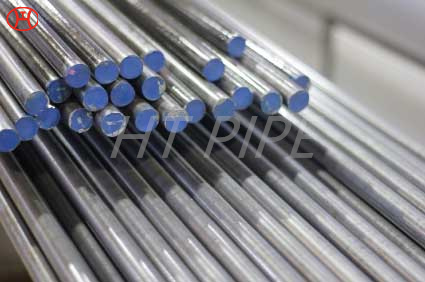
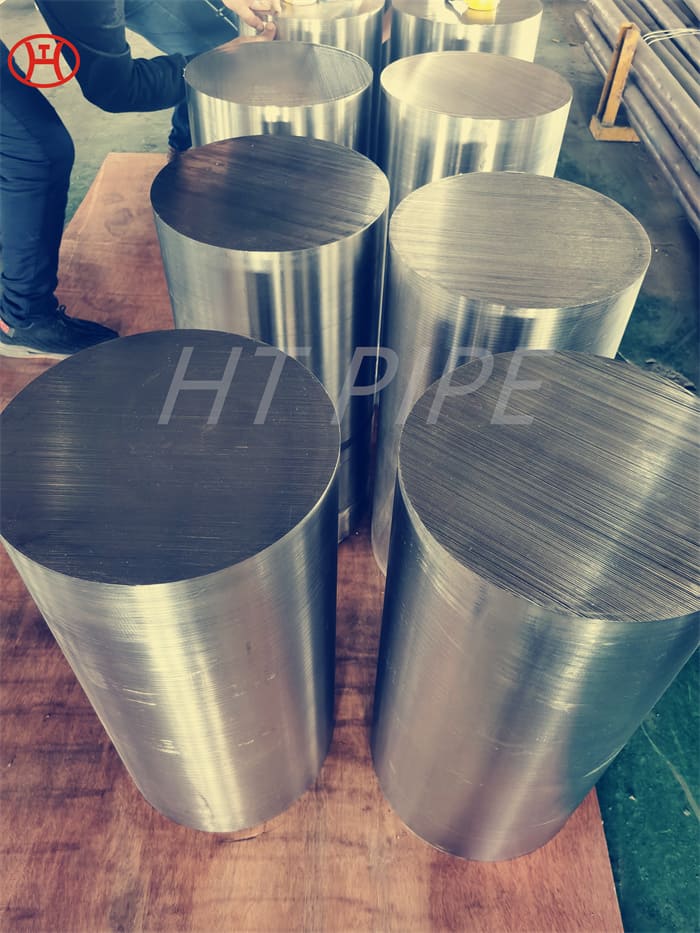
The high performance alloy Inconel 718 round bar inherently derives many good properties from nickel. Inconel 718 bar falls within the scope of the ASTM B637 specification, which in turn covers nickel-based hot-worked and cold-worked precipitation hardening alloys.
Alloy 718 is a precipitation hardening nickel-chromium alloy containing large amounts of iron, niobium and molybdenum, and small amounts of aluminum and titanium. It is sometimes called a “super alloy”.
Inconel 718 alloy is a precipitation hardenable nickel-based alloy. It has good ductility in the annealed condition and very high yield, tensile and creep rupture properties at temperatures up to 1300 degrees Fahrenheit.
Inconel 718 is a precipitation hardening nickel-chromium based superalloy. ASTM B637 UNS N07718 round bars also contain significant amounts of elements such as iron, niobium and molybdenum, and trace amounts of metals such as aluminum and titanium. Aluminum and titanium make Inconel 718 hardenable.
S32760 also has high strength and extended service life. It is 10% lighter than grade 316 steel, ideal for sub-zero use, and more cost-effective than nickel alloys. Stainless steel grade F55 can be easily machined and welded.
Super Duplex S32760 Bar proves to be an excellent replacement for austenitic grades in marine environments. Super Duplex S32760 round bar (ASTM A276/ ASTM A479) exhibits good heat resistance up to 300¡ã.
The dual microstructure and chemical composition of ASME SA 479 UNS S32760 bar makes it a high performance alloy. Due to its designation as a superalloy, most manufacturers are aware of the very valuable mechanical properties of F55 UNS 32760 Hex Bar.
Super Duplex is composed of 24% to 26% chromium, 6% to 8% nickel, 3% molybdenum and 1.2% manganese, with the remainder being iron. Trace amounts of carbon, phosphorus, sulfur, silicon, nitrogen, and copper were also found in Super Duplex.
Duplex alloys have some of the ferritic stress corrosion cracking resistance of common austenitic stainless alloys and many of the superior formability properties that are more cost effective than high nickel alloys.
Its impact strength or hardness properties inherited from the ferritic side make 2507 stainless steel round bar suitable for structural applications including bridge construction and more.
It is a super duplex alloy, so heat resistance is also what Super Duplex 2507 rods are capable of. River or sea water often contains highly corrosive chemicals containing sulfur or chloride ions, and materials such as the 2507 Super Duplex Round Bar can withstand these chemicals.
Since the material is also resistant to acids and chlorine compounds, it could see its application in marine environments, especially in saltwater containing chlorine compounds. The ferritic portion of the duplex structure of Super Duplex 2507 round bar alloy makes it resistant to stress corrosion cracking in warm chloride-containing environments.
Super Duplex UNS S32760 is one of the most common super duplex grades on the market. UNS S32760 is a duplex stainless steel designed for use in corrosive chlorine-containing environments, with the addition of W and Cu compared to UNS S32750.
S32760 has very good resistance to localized corrosion and stress corrosion cracking and high mechanical strength.
Duplex 2205 round steel contains 22% chromium, 3% molybdenum, and 5-6% nickel. In addition to excellent impact toughness and high strength, it also has high general, local and stress corrosion resistance.
Duplex 1.4462 round bars also have low thermal expansion and high thermal conductivity as well as high corrosion and erosion fatigue properties compared to austenite. The corrosion resistance of duplex 2205 is almost twice that of other austenitic stainless steels.
2205 has good solderability. The motivation for welding dual-phase steels is to maintain the corrosion resistance, toughness and strength of the base metal in the weld metal and heat affected zone.
Duplex steels are also magnetic, a property that can be used to easily distinguish them from ordinary austenitic stainless grades.
The advantages of duplex steels include: good weldability and machinability, high resistance to corrosion fatigue, resistance to stress corrosion cracking (especially chloride stress corrosion cracking), erosion and high energy absorption.
S31803 Duplex Steel is a 22% chromium duplex (austenitic/ferritic) steel with moderate to good strength and good general corrosion/stress corrosion/cracking resistance.
The 2205 was developed to provide excellent machinability. Control of composition and inclusion type improves chip formation and reduces tool wear, resulting in higher machining efficiency and lower tool costs.
Our Duplex Steel S31803 bar is an industrially processed nitrogen-modified steel that addresses common corrosion problems encountered with 300 series stainless steels.
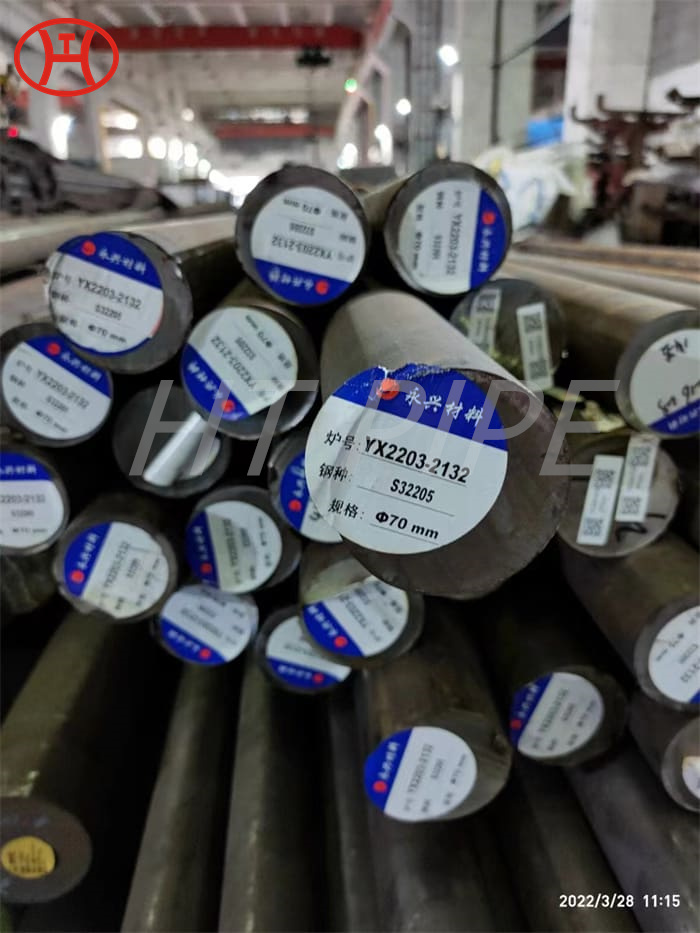
Duplex ( UNS S31803 / S32205 ) rods, also known as steel rods (ASTM A276 / ASTM A479 ), have excellent corrosion resistance. Stainless steel rods/stainless steel rods ( en 1.4462 ) are resistant to intergranular and crevice corrosion.
Duplex steel UNS S31803 round bars are known as stainless austenitic-ferritic, with equal amounts of ferrite and austenite.