Molybdenum-Bearing 18/10 Austenitic Stainless for Chloride Service
|
UNS NUMBER
S31600
|
ALLOY FAMILY
Austenitic (Mo-bearing)
|
STRUCTURE
100% Austenite
|
UTS (MIN)
≥515 MPa
|
MAX TEMP
~870°C
|
DENSITY
7.98 g/cm³
|
|
Stainless Steel 316 (UNS S31600) adds 2–3% molybdenum to the 18/10 austenitic base, lifting pitting and crevice corrosion resistance (PREN ~26) above 304. It is the standard marine, chemical, and pharmaceutical grade where chlorides are present but temperatures stay moderate.
|
|
Cr
16–18%
Oxidation resistance
|
Ni
10–14%
Austenite stabilizer
|
Mo
2–3%
Pitting / crevice resistance
|
N
≤0.10%
Minor
|
|
UTS
≥515 MPa
|
YS 0.2%
≥205 MPa
|
Elong.
≥40%
|
Service
-196~870°C
|
What is Stainless Steel 316?
316 is the molybdenum-bearing evolution of 304. The 2–3% molybdenum is the key addition: it markedly improves resistance to pitting and crevice corrosion in chloride environments and to a range of process chemicals, raising PREN from about 19 (304) to about 26. Carbon runs up to 0.08%, the same as 304.
This is the grade most coastal, marine, and chemical-process systems specify by default. The trade-off versus 304 is a modest cost premium and slightly lower machinability. For welded fabrications that will not be post-weld annealed, the low-carbon 316L is the safer choice because it avoids sensitization. Where higher strength or temperature is needed, 316H, 316Ti, or 317L take over.
Chemical Composition (Weight %)
| Element |
Min (%) |
Max (%) |
Role in Alloy |
| Chromium (Cr) |
16.0 |
18.0 |
Oxidation resistance |
| Nickel (Ni) |
10.0 |
14.0 |
Austenite stabilizer |
| Molybdenum (Mo) |
2.0 |
3.0 |
Pitting / crevice resistance |
| Carbon (C) |
— |
0.08 |
Kept low; 0.04–0.10% risks sensitization |
| Manganese (Mn) |
— |
2.00 |
Deoxidizer |
| Silicon (Si) |
— |
1.00 |
Deoxidizer |
| Phosphorus (P) |
— |
0.045 |
Impurity |
| Sulfur (S) |
— |
0.030 |
Impurity |
| Nitrogen (N) |
— |
0.10 |
Minor |
| Iron (Fe) |
Balance |
— |
Matrix former |
★ Molybdenum 2–3% is the defining addition over 304. As with 304, carbon up to 0.08% means welded thick sections can sensitize in the 425–815°C range; use 316L for as-welded fabrications.
Mechanical Properties
Values are for the solution-annealed condition per ASTM A240, A182 (F316), and A312 (TP316).
| Condition / Form |
UTS (MPa) |
YS 0.2% (MPa) |
Elong. % (min) |
Hardness (max) |
| Minimum (ASTM A240 / A182 F316) |
≥515 |
≥205 |
40 |
217 HBW (95 HRB) |
| Typical mill-annealed |
515–700 |
205–340 |
45–55 |
150–200 HBW |
Modulus of Elasticity 193 GPa; Shear Modulus 77 GPa; Poisson's Ratio 0.29. Cold work raises yield and tensile strength. Not hardenable by heat treatment.
Physical Properties
| Property |
Value |
Note |
| Density |
7.98 g/cm³ |
Slightly above 304 |
| Melting Range |
1375–1400°C |
Solidus ~1375°C |
| Thermal Conductivity (100°C) |
16.3 W/m·K |
Comparable to austenitics |
| Thermal Expansion (20–100°C) |
16.0 ×10⁻⁶ /K |
Higher than carbon steel |
| Specific Heat |
500 J/kg·K |
At 21°C |
| Electrical Resistivity |
0.74 µΩ·m |
At 21°C |
| Magnetic Property |
Non-magnetic* |
*Slight after cold work |
| PREN (Pitting Resistance) |
~26 |
PREN = %Cr + 3.3×%Mo + 16×%N |
Corrosion Resistance
Pitting & Crevice Corrosion
The molybdenum lifts PREN to ~26, giving 316 a Critical Pitting Temperature around 20–25°C in ferric chloride — noticeably better than 304. It still pits in warm or stagnant seawater and in crevices above ~25–30°C.
Marine & Chloride Service
316 is the standard grade for coastal architecture, marine hardware, and process streams with chlorides at moderate temperature. For warm seawater, step up to 904L, AL6XN, or 254SMO.
General & Process Chemicals
Resists many organic acids, phosphoric, and acetic acids better than 304. It is widely used in pharmaceutical and food plants for cleanability and corrosion margin.
High-Temperature Limit
Above ~650°C, 316 can form brittle sigma phase; for sustained high-temperature load use 316H, 321, or 347. Oxidation resistance is good to ~870°C.
Stainless Steel 316 vs Similar Grades — Selection Guide
| If you need... |
Choose... |
Why |
| Marine, chloride, pharmaceutical |
316 / 316L |
Molybdenum pitting resistance |
| Welded vessel not PWHT |
316L |
C ≤ 0.030% avoids sensitization |
| Warm seawater / aggressive Cl⁻ |
904L / 254SMO |
PREN 36–45 |
| High-temp >650°C load |
316H / 321H |
Creep + stabilized |
| General low-chloride |
304 / 304L |
Lower cost |
Applicable Standards
| Standard |
Product Form |
| ASTM A240 |
Plate, sheet, strip |
| ASTM A182 F316 |
Forged flanges & fittings |
| ASTM A403 WP316 |
Butt-weld fittings |
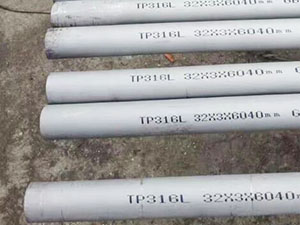
| ASTM A312 TP316 |
Seamless & welded pipe |
| ASTM A213 / A269 |
Tube |
| ASTM A276 / A479 |
Bar, rod, forging stock |
HT PIPE Supply — Stainless Steel 316 Product Forms
| Product Form |
Specifications |
HT PIPE Supply |
| Seamless Pipe |
ASTM A312 TP316 |
✅ Available |
| Welded Pipe |
ASTM A312 TP316 |
✅ Available |
| Forged Flanges |
ASTM A182 F316, ASME B16.5/B16.47 |
✅ In stock |
| Butt-Weld Fittings |
ASTM A403 WP316 |
✅ Available |
| Plate / Sheet |
ASTM A240 |
✅ Available |
| Bar / Rod |
ASTM A276 / A479 |
✅ Available |
HT PIPE supplies 316 (and 316L) in pipe, flanges, fittings, plate, and bar with full MTRs. For welded systems we recommend 316L to avoid sensitization.
Project Experience — Stainless Steel 316
HT PIPE supplies 316 for marine, chemical, pharmaceutical, and food process systems worldwide.
| Project |
Product |
Specification |
| Offshore Topside Piping (North Sea) |
316L Pipe + Fittings |
A312, A403 |
| Pharmaceutical Clean Utility (Europe) |
316L Tube + Fittings |
A269, A403 |
| Chemical Process Skid (China) |
316 Flanges + Plate |
A182 F316, A240 |
Our team advises 316 vs 316L and performs PMI verification for chloride-sensitive service.
| FREQUENTLY ASKED QUESTIONS |
|
FAQ — Stainless Steel 316
| What is the difference between 316 and 316L? |
| 316 allows carbon up to 0.08%; 316L caps it at 0.030%. The lower carbon prevents sensitization during welding, so 316L is used for welded fabrications that will not be post-weld annealed. Strength minima are slightly lower for 316L (485/170 versus 515/205 MPa). |
| Why does 316 resist corrosion better than 304? |
| The 2–3% molybdenum raises PREN from ~19 to ~26, improving resistance to pitting and crevice corrosion in chloride environments. That is why 316 is chosen for marine and chemical service. |
| Is 316 good in seawater? |
| At ambient temperature with flow, 316 is widely used in coastal and splash-zone service, but it can pit in warm, stagnant, or creviced seawater. For warm seawater use 904L, AL6XN, or 254SMO. |
| What filler is used for 316? |
| ER316 / E316. For welded joints that may sit in the sensitizing range, use ER316L to keep the deposit low-carbon. |
| Can 316 be used at high temperature? |
| Oxidation resistance is good to about 870°C, but above ~650°C 316 risks sigma-phase embrittlement. For sustained high-temperature load, use 316H, 321, or 347. |
|
Need Stainless Steel 316 for Your Project?
HT PIPE supplies 316 seamless pipe, butt-weld fittings, forged flanges, and plate with full MTR documentation. Contact our technical team for material selection and welding advice.
Request a Quote |
|
MATERIAL PAGE
|
COMPARISON
|
MATERIAL PAGE
|
PRODUCT PAGE
|