1. Scope and Class Designations
ASME B16.11 covers ratings, dimensions, tolerances, marking and material requirements for forged socket-welding and threaded fittings in sizes NPS 1/8 through NPS 4 (DN 6 through DN 100). It applies to elbows, tees, crosses, couplings, half couplings, caps, plugs, bushings and bosses.
| End connection |
Pressure classes covered |
Rating basis |
| Socket welding |
Class 3000, 6000 and 9000 |
Wall thickness of the fitting body; the joint is completed by a fillet weld |
| Threaded (NPT) |
Class 2000, 3000 and 6000 |
Wall thickness of the fitting body plus the thread |
The B16.11 class numbers are not flange classes. A Class 3000 socket-weld fitting has nothing to do with an ASME B16.5 Class 300 flange, and there is no Class 3000 in ASME B16.5. Never rate a forged fitting by cross-referencing a flange class.
Class 9000 socket-weld fittings and Class 6000 threaded fittings are made only in the smaller sizes: Class 9000 stops at NPS 2 and Class 6000 socket-weld at NPS 2. Sizes above those are supplied in Class 3000.
Sizes are shown in this page as NPS to match the standard. The corresponding DN values are DN 6, 8, 10, 15, 20, 25, 32, 40, 50, 65, 80 and 100 for NPS 1/8 through 4.
2. Dimensional Letter Designations
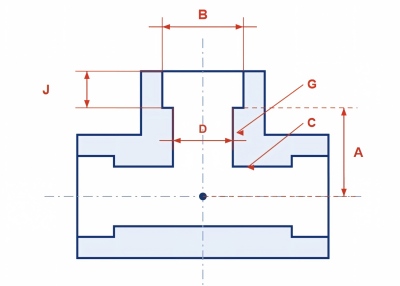
Figure 1 — Socket-weld tee shown in section. The same letters are used for elbows, crosses and couplings. A, B and J are the dimensions that govern correct fit-up.
| Letter |
Definition |
Why it matters |
| A |
Centre to bottom of socket. For a tee the value applies to all three openings |
Sets the laying-out dimension of the fitting and, with J, the face-to-centre distance |
| B |
Socket bore, minimum and maximum |
The pipe outside diameter must fall inside this band. B is not the pipe outside diameter of a specific schedule |
| J |
Depth of socket, minimum |
Together with the 1.6 mm expansion gap it fixes how far the pipe is inserted |
| D |
Bore diameter of the fitting, minimum and maximum |
The through bore; governs flow area |
| C |
Socket wall thickness (average) |
Controls the strength of the welded socket |
| G |
Body wall thickness, minimum |
Controls the pressure containment of the body |
3. Socket Bore (B) and Socket Wall Thickness (C)
The socket bore B is given as a minimum and maximum. Filling the column with the pipe outside diameter of one schedule (for example 21.34 mm for NPS 1/2) is a common error: the socket must be slightly larger than the pipe so that the pipe can enter, and the tolerance band is what the standard controls. Socket wall thickness C is stated as an average, with a lower minimum permitted in localised areas.
| NPS |
DN |
B min (mm) |
B max (mm) |
C min — Cl. 3000 |
C min — Cl. 6000 |
C min — Cl. 9000 |
| 1/8 |
6 |
10.8 |
11.2 |
3.18 |
3.43 |
— |
| 1/4 |
8 |
14.2 |
14.6 |
3.3 |
4.01 |
— |
| 3/8 |
10 |
17.6 |
18.0 |
3.5 |
4.37 |
— |
| 1/2 |
15 |
21.8 |
22.2 |
4.09 |
5.18 |
8.18 |
| 3/4 |
20 |
27.2 |
27.6 |
4.27 |
6.04 |
8.56 |
| 1 |
25 |
33.9 |
34.3 |
4.98 |
6.93 |
9.96 |
| 1-1/4 |
32 |
42.7 |
43.1 |
5.28 |
6.93 |
10.62 |
| 1-1/2 |
40 |
48.8 |
49.2 |
5.54 |
7.8 |
11.12 |
| 2 |
50 |
61.2 |
61.7 |
6.04 |
9.5 |
12.12 |
| 2-1/2 |
65 |
73.9 |
74.4 |
7.67 |
— |
— |
| 3 |
80 |
89.8 |
90.3 |
8.3 |
— |
— |
| 4 |
100 |
115.2 |
115.7 |
9.35 |
— |
— |
4. Bore Diameter (D) by Pressure Class
The bore narrows as the class rises, because the wall is thicker for the same outside envelope. A Class 9000 NPS 2 fitting has a bore of about 37–39 mm, against 52–53 mm for the Class 3000 fitting of the same size.
| NPS |
DN |
D 3000 min / max |
D 6000 min / max |
D 9000 min / max |
| 1/8 |
6 |
6.1 / 7.6 |
3.2 / 4.8 |
— |
| 1/4 |
8 |
8.5 / 10.0 |
5.6 / 7.1 |
— |
| 3/8 |
10 |
11.8 / 13.3 |
8.4 / 9.9 |
— |
| 1/2 |
15 |
15.0 / 16.6 |
11.0 / 12.5 |
5.6 / 7.2 |
| 3/4 |
20 |
20.2 / 21.7 |
14.8 / 16.3 |
10.3 / 11.8 |
| 1 |
25 |
25.9 / 27.4 |
19.9 / 21.5 |
14.4 / 16.0 |
| 1-1/4 |
32 |
34.3 / 35.8 |
28.7 / 30.2 |
22.2 / 23.5 |
| 1-1/2 |
40 |
40.1 / 41.6 |
33.2 / 34.7 |
27.2 / 28.7 |
| 2 |
50 |
51.7 / 53.3 |
42.1 / 43.6 |
37.4 / 38.9 |
| 2-1/2 |
65 |
61.2 / 64.2 |
— |
— |
| 3 |
80 |
76.4 / 79.4 |
— |
— |
| 4 |
100 |
100.7 / 103.8 |
— |
— |
5. Socket Depth (J) and Centre to Bottom of Socket (A)
Socket depth J does not depend on the pressure class: it is fixed by size. The centre-to-bottom dimension A does depend on the class, because a thicker fitting body moves the socket bottom further from the centre. Values below are for 90° elbows, tees and crosses. A for 45° elbows is a separate, shorter value.
| NPS |
DN |
J min (mm) |
A 3000 — 90° |
A 6000 — 90° |
A 9000 — 90° |
A 3000 — 45° |
A 6000 — 45° |
A 9000 — 45° |
| 1/8 |
6 |
9.5 |
11 |
11 |
— |
8 |
8 |
— |
| 1/4 |
8 |
9.5 |
11 |
13.5 |
— |
8 |
8 |
— |
| 3/8 |
10 |
9.5 |
13.5 |
15.5 |
— |
8 |
11 |
— |
| 1/2 |
15 |
9.5 |
15.5 |
19 |
25.5 |
11 |
12.5 |
15.5 |
| 3/4 |
20 |
12.5 |
19 |
22.5 |
28.5 |
13 |
14 |
19 |
| 1 |
25 |
12.5 |
22.5 |
27 |
32 |
14 |
17.5 |
20.5 |
| 1-1/4 |
32 |
12.5 |
27 |
32 |
35 |
17.5 |
20.5 |
22.5 |
| 1-1/2 |
40 |
12.5 |
32 |
38 |
38 |
20.5 |
25.5 |
25.5 |
| 2 |
50 |
16.0 |
38 |
41 |
54 |
25.5 |
28.5 |
28.5 |
| 2-1/2 |
65 |
16.0 |
41 |
— |
— |
28.5 |
— |
— |
| 3 |
80 |
16.0 |
57 |
— |
— |
32 |
— |
— |
| 4 |
100 |
19.0 |
66.5 |
— |
— |
41 |
— |
— |
Dimensional tolerances on A: ±1.5 mm for NPS 1/2 and 3/4, ±2 mm for NPS 1 to 2, and ±2.5 mm for NPS 2-1/2 to 4.
6. Couplings and Half Couplings — Laying Lengths (E, F)
E and F are laying lengths as defined in the ASME B16.11 sketch; they are not the overall length of the fitting. E is the distance the pipe ends stand apart inside a full coupling, and F the corresponding distance for a half coupling. Where a full coupling is used, the raw length of stock to allow is roughly E + 2J.
| NPS |
DN |
E — full coupling (mm) |
F — half coupling (mm) |
| 1/8 |
6 |
6.5 |
16 |
| 1/4 |
8 |
6.5 |
16 |
| 3/8 |
10 |
6.5 |
17.5 |
| 1/2 |
15 |
9.5 |
22.5 |
| 3/4 |
20 |
9.5 |
24 |
| 1 |
25 |
12.5 |
28.5 |
| 1-1/4 |
32 |
12.5 |
30 |
| 1-1/2 |
40 |
12.5 |
32 |
| 2 |
50 |
19 |
41 |
| 2-1/2 |
65 |
19 |
43 |
| 3 |
80 |
19 |
44.5 |
| 4 |
100 |
19 |
48 |
7. Product Types — What B16.11 Does and Does Not Cover
| Product |
Covered by B16.11? |
Notes |
| 90° and 45° elbows, tees, crosses |
Yes |
Socket-weld and threaded ends |
| Full coupling, half coupling, reducing coupling |
Yes |
Half couplings are supplied plain or with a beveled end for welding to a header |
| Welding boss / outlet |
Yes |
Branch connection welded onto the outside of a run pipe |
| Cap |
Yes |
A cap is a closed-end fitting and has no drive head. Socket-weld caps are machined for a socket at the open end (threaded caps for an NPT end) |
| Plug |
Yes |
A plug has a hex or square drive head; this is the part most often confused with a cap |
| Bushing |
Yes |
Reducing threaded bushing |
| Straight reducer |
No |
B16.11 contains no straight (concentric) forged reducer. Use a swage nipple per MSS SP-95, or a butt-weld reducer per ASME B16.9 |
| Union |
No |
Unions are covered by MSS SP-83, not by B16.11 |
| Street elbow |
Yes (threaded) |
One threaded end and one socket or threaded end |
8. Material Specifications
The forging material is called out separately from B16.11. Common combinations:
| Family |
ASTM specification |
Typical grades |
| Carbon steel |
ASTM A105 |
A105 |
| Low-temperature carbon steel |
ASTM A350 |
LF2, LF3 |
| Alloy steel |
ASTM A182 |
F5, F9, F11, F22, F91 |
| Austenitic stainless steel |
ASTM A182 |
F304/304L, F316/316L, F321, F347 |
| Duplex and super duplex |
ASTM A182 |
F51 (S31803), F53 (S32750), F55 (S32760) |
| Nickel alloys |
ASTM B564 |
Inconel 600/625, Incoloy 800/825, Monel 400, Hastelloy C276, Alloy 20 |
9. Socket-Weld Preparation and the 1.6 mm Expansion Gap
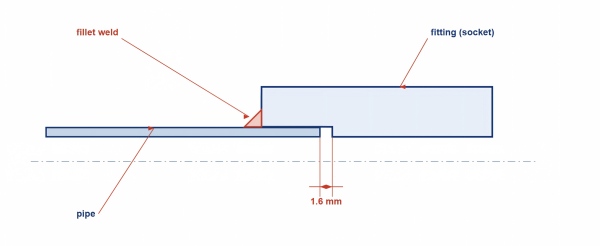
Figure 2 — Socket-weld assembly. The pipe is withdrawn about 1.6 mm (1/16 in) from the socket bottom before welding, so that differential thermal expansion cannot push the pipe into the socket bottom and crack the weld.
ASME B16.11 defines the fitting. It does not define how the joint is welded. The welding requirements come from the applicable piping code, normally ASME B31.1 or B31.3, which call for:
- A fillet weld at the socket mouth, with a minimum leg size of 1.09 × the pipe wall thickness.
- A gap of about 1.6 mm (1/16 in) between the pipe end and the socket bottom before welding, so that thermal expansion of the pipe cannot load the weld. The gap appears in B31.1 / B31.3 Fig. 328.5.2C, not in B16.11.
- A plain end on the pipe Socket-weld fittings take an un-beveled (square-cut) pipe end. A beveled end must be cut back flush before insertion.
- Pre-cleaning both surfaces free of oil, scale and rust before welding.
A 1/16 in gap must be verified before welding, not backed off by feel. Where the pipe will operate hot, the gap is good practice rather than an option.
10. Threaded Ends
Threaded B16.11 fittings use NPT taper threads in the sizes covered. Class 2000 is the standard threaded class, with Class 3000 and 6000 available in the smaller sizes. Threaded joints are used where welding is impractical or where the line must be broken for maintenance; they are not accepted in most hydrocarbon specifications for sizes above NPS 2. Threads must be inspected with a plug or ring gauge, and a thread sealant compatible with the process is required at assembly.
11. Marking and Traceability
| Marking element |
Example |
| Manufacturer name or trademark |
HT PIPE |
| Material designation |
A182 F316L |
| Size |
NPS 1 |
| Pressure class |
3000 |
| Compliance marking |
B16.11 |
| End type |
SW (socket weld) or THD (threaded) |
| Heat number or batch number |
Heat No. |
12. Related Standards
| Standard |
Title and relevance |
| ASME B16.5 |
Pipe flanges. Cited only for the flanged end of a component, never as the rating basis of a B16.11 fitting |
| ASME B16.9 |
Buttwelding fittings, for sizes and connections outside B16.11 |
| ASME B1.20.1 |
Pipe Threads, General Purpose (NPT and NPSC) |
| ASME B31.1 / B31.3 |
Power Piping / Process Piping: joint design, gap, weld size, NDT |
| ASME B36.10M / B36.19M |
Pipe dimensions, used to select the pipe that enters the socket |
| MSS SP-83 |
Steel Pipe Unions, Socket-Welding and Threaded |
| MSS SP-95 |
Swage(d) Nipples and Bull Plugs |
| MSS SP-97 |
Integrally Reinforced Forged Branch Outlet Fittings, socket-welding, threaded and buttwelding ends |
13. How to Order
| Order element |
Specify |
Example |
| Standard |
ASME B16.11 |
B16.11 |
| Product |
Elbow, tee, cross, coupling, cap, plug, bushing, boss |
Coupling |
| End connection |
Socket welding or threaded |
Socket welding |
| Pressure class |
2000 / 3000 / 6000 / 9000 |
3000 |
| Size |
NPS |
NPS 1 |
| Material grade |
Per purchase order |
ASTM A182 F316L |
| Quantity |
Number of pieces |
50 |
| Certification |
Type of inspection certificate if required |
EN 10204 3.1 MTC |
14. FAQ — Frequently Asked Questions
What sizes does ASME B16.11 cover?
NPS 1/8 through NPS 4 (DN 6 through DN 100). Socket-weld fittings are made in Class 3000, 6000 and 9000; threaded fittings in Class 2000, 3000 and 6000. Class 9000 stops at NPS 2 and Class 6000 socket-weld also stops at NPS 2.
Is a B16.11 Class 3000 fitting the same as an ASME B16.5 Class 300 flange?
No. The class numbers come from two different systems. B16.11 rates a forged fitting by its body wall; B16.5 rates a flange by a pressure–temperature table. There is no Class 3000 in B16.5 at all, and a Class 3000 fitting and a Class 300 flange have no relationship.
What should the socket bore B value be for NPS 1/2?
Between 21.8 mm and 22.2 mm. The pipe outside diameter for NPS 1/2 is 21.3 mm, so B is deliberately larger than the pipe. Filling the socket bore column with 21.34 mm (the pipe OD) is a common catalogue error.
Do I need a 1.6 mm gap when socket welding?
Yes, as good practice and as required by ASME B31.1 and B31.3 for hot service. Withdraw the pipe about 1/16 in from the socket bottom before welding so that expansion of the pipe cannot drive it into the socket bottom and crack the fillet weld. The requirement is in the piping code, not in B16.11.
Is a socket-weld cap the same as a plug?
No. A cap fits over the pipe and has no drive head. A plug is threaded (or socket-weld) and has a hex or square head so that it can be tightened with a wrench. Only the plug has a drive head.
Does ASME B16.11 include straight reducers?
No. There is no straight forged reducer in B16.11. Where a reduction is needed with small-bore connections, use a swage nipple to MSS SP-95 or a butt-weld reducer to ASME B16.9.
Are unions covered by ASME B16.11?
No. Socket-welding and threaded steel pipe unions are covered by MSS SP-83. B16.11 covers couplings, which are permanently installed fittings, not unions.
What weld size is required on a socket joint?
A fillet weld with a minimum leg of 1.09 × the nominal pipe wall thickness, applied at the socket mouth. The weld size, examination and any preheat requirements are set by the applicable B31 code and the project specification.