ASTM A269 / A269M — Seamless and Welded Austenitic Stainless Steel Tubing
ASTM A269/A269M (latest edition: A269M-24) covers the most widely used austenitic stainless steel tubing specification for general corrosion-resistant service. ASME SA-269 is adopted in BPVC Section II Part A for heat-exchanger tubing in pressure vessels. Unlike ASTM A213 (which targets boiler and superheater tubes at elevated temperatures), A269 is designed for general-purpose service — including instrument tubing, heat exchanger tubing, chemical plant process lines, and food and beverage processing. It covers both seamless (drawn) and welded (EFW/ERW) tubing in OD × wall-thickness dimensions.
1. Scope and Related Standards
| Standard |
Scope |
| ASTM A269 / ASME SA-269 |
Austenitic SS tubing for general service (this specification) |
| ASTM A213 / ASME SA-213 |
Austenitic + ferritic SS boiler, superheater, and heat-exchanger tubes (elevated temperature service) |
| ASTM A312 / ASME SA-312 |
Austenitic SS seamless and welded pipe (NPS-schedule based, larger diameter) |
| ASTM A789 / ASME SA-789 |
Duplex SS tubing for general service (companion duplex spec) |
| ASTM A249 / ASME SA-249 |
Welded austenitic SS boiler tubes (welded equivalent of A213 austenitic grades) |
2. Grades Covered
| Grade |
UNS No. |
Alloy |
Key Feature |
Typical Application |
| TP304 |
S30400 |
18Cr-8Ni |
General purpose austenitic; C ≤ 0.08% |
General corrosion, food, water |
| TP304L |
S30403 |
18Cr-8Ni (low-C) |
C ≤ 0.030%; no sensitisation in welded condition |
Instrument tubing, welded assemblies, pharmaceutical |
| TP316 |
S31600 |
16Cr-12Ni-2Mo |
2Mo for chloride resistance; C ≤ 0.08% |
Marine, chemical, heat exchangers in chloride media |
| TP316L |
S31603 |
16Cr-12Ni-2Mo (low-C) |
C ≤ 0.030%; most common instrument tube grade |
Offshore instrument tubing, cryogenic, highly corrosive media |
| TP317 |
S31700 |
18Cr-15Ni-3Mo |
Higher Mo than 316; better chloride resistance |
Pulp and paper, sulphurous acid |
| TP321 |
S32100 |
18Cr-9Ni-Ti |
Ti-stabilised; no sensitisation 425–900 °C |
General tubing for temperatures 425–900 °C |
| TP347 |
S34700 |
18Cr-9Ni-Nb |
Nb+Ta stabilised; higher creep than TP321 |
High-temperature tubing, power and chemical plant |
3. Chemical Composition
| Grade |
C max |
Mn max |
Si max |
Cr |
Ni |
Mo |
Others |
| TP304 |
0.08 |
2.00 |
0.75 |
18.0–20.0 |
8.0–10.5 |
— |
N ≤0.10 |
| TP304L |
0.030 |
2.00 |
0.75 |
18.0–20.0 |
8.0–12.0 |
— |
N ≤0.10 |
| TP316 |
0.08 |
2.00 |
0.75 |
16.0–18.0 |
10.0–14.0 |
2.00–3.00 |
N ≤0.10 |
| TP316L |
0.030 |
2.00 |
0.75 |
16.0–18.0 |
10.0–15.0 |
2.00–3.00 |
N ≤0.10 |
| TP317 |
0.08 |
2.00 |
0.75 |
18.0–20.0 |
11.0–15.0 |
3.00–4.00 |
— |
| TP321 |
0.08 |
2.00 |
0.75 |
17.0–19.0 |
9.0–12.0 |
— |
Ti ≥5×C, ≤0.70 |
| TP347 |
0.08 |
2.00 |
0.75 |
17.0–19.0 |
9.0–13.0 |
— |
Nb+Ta ≥10×C, ≤1.10 |
4. Mechanical Properties
| Grade |
UTS min (MPa) |
YS min (MPa) |
Elong. min (%) |
Hardness max (HBW) |
| TP304 / TP316 |
515 |
205 |
35 |
192 |
| TP304L / TP316L |
485 |
170 |
35 |
192 |
| TP317 |
515 |
205 |
35 |
192 |
| TP321 / TP347 |
515 |
205 |
35 |
192 |
5. Heat Treatment
All A269 tubing must be furnished in the annealed (solution-annealed) condition. Solution annealing at 1040–1150 °C with rapid cooling ensures full dissolution of carbides and restoration of corrosion resistance. This is mandatory for both seamless and welded tubes. Welded tubes must also pass the reverse flattening test (or flare test) to verify weld integrity.
6. Testing Requirements
| Test |
Method |
Condition |
| Leak Test |
Hydrostatic test OR eddy current (ET) |
Each tube; either method unless PO specifies |
| Tensile |
ASTM E8 / E8M |
One per heat or heat-treatment lot |
| Flattening (welded) |
Reverse flattening per A269 |
Weld seam at 90° to the force; no cracks acceptable |
| Flare (seamless small OD) |
Expand end to 60° included angle |
No cracks or splits |
| Chemical Analysis |
One ladle per heat |
Mandatory |
| Visual & Dimensional |
100%; OD/wall tolerance per A269 Table |
OD and wall tolerance tighter than pipe |
7. Typical Applications by Industry
| Industry |
Grade |
Application |
| Offshore / Oil & Gas |
TP316L |
Instrument tubing, hydraulic control lines (¼″ OD × 0.035″ wall) |
| Chemical & Petrochemical |
TP304L, TP316L |
Heat exchanger tubing, process sample lines, impulse tubing |
| Food, Dairy, Pharmaceutical |
TP304L, TP316L |
CIP/SIP tubing, sterile process connections |
| Power Generation |
TP321, TP347 |
Heat exchanger tubing at 425–900 °C service temperature |
| Cryogenic (LNG, LOX) |
TP304L, TP316L |
Cryogenic transfer tubing, instrument lines to –196 °C |
| Marine & Desalination |
TP316L, TP317 |
Heat exchanger tubing in seawater and brine service |
8. A269 vs A213 — Key Differences
| Aspect |
ASTM A269 |
ASTM A213 |
| Primary use |
General corrosion-resistant service, instrument tubing |
Boiler, superheater, heat-exchanger under ASME BPVC |
| Ferritic grades |
Not included |
T11, T22, T91, T92 included |
| 'H' grades (high carbon) |
Not included; no TP304H/TP347H |
TP304H, TP316H, TP321H, TP347H included |
| Grain size requirement |
None |
ASTM No. 7 or coarser for H-grades in BPVC service |
| Welded tubing |
Included (with flattening test) |
Included (with flattening/reverse-flattening test) |
| Applicable code |
General service; ASME SA-269 for heat exchangers |
ASME BPVC boiler code; SA-213 mandatory for boilers |
9. How to Order
| # |
Item |
Example |
| 1 |
Standard |
ASTM A269M-24 or ASME SA-269 |
| 2 |
Grade |
TP316L or TP304L |
| 3 |
OD × Wall |
6.35 mm (¼ in) OD × 0.89 mm (0.035 in) wall — common instrument tube size |
| 4 |
Seamless or Welded |
Seamless (SMLS) for higher integrity; Welded (EFW/ERW) for lower cost |
| 5 |
Finish |
Bright annealed (BA) for instrument tubing; pickled & passivated for heat exchangers |
| 6 |
Leak test |
Eddy current (ET) or hydrostatic — specify preference |
| 7 |
Certificate |
EN 10204 3.1 MTR |
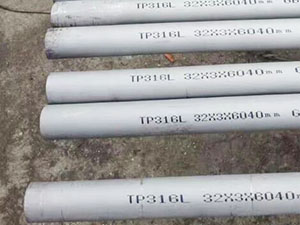
HT PIPE supplies ASTM A269 austenitic stainless steel tubing in TP304/L, TP316/L, TP321, and TP347 grades, from OD 3.17 mm to 101.6 mm, seamless and welded, bright annealed or pickled. Contact us for instrument tubing and heat exchanger tube specifications.
10. Frequently Asked Questions
Q1: Should I specify seamless or welded A269 tubing for instrument lines?
For safety-critical or high-pressure instrument tubing (above 100 bar), seamless tubing is strongly recommended — it has no weld seam and therefore no risk of weld defects. For general process instrument lines at moderate pressure, high-quality cold-drawn EFW welded tubing (with 100% ET and reverse flattening test) is acceptable and significantly lower cost. The choice between seamless and welded should be driven by the design pressure, criticality, and applicable project piping class.
Q2: What is "bright annealed" (BA) finish on A269 tubing?
Bright annealed tubing is solution-annealed in a controlled reducing or inert atmosphere (hydrogen or cracked ammonia), preventing surface oxidation and producing a clean, shiny internal and external surface without pickling or passivation treatment. BA finish is preferred for instrument and control tubing (no scale, no pickling acid residue), food and pharmaceutical applications (hygienic surface), and any service where the tube will be bent or formed after delivery (scale-free surface reduces tool wear). BA tubing meeting ASTM A269 is commonly used with compression tube fittings (Swagelok, Parker, Gyrolok) in offshore and chemical plant instrumentation.