1. Scope and Designation
ASME B16.5 covers pressure–temperature ratings, materials, dimensions, tolerances, marking and testing for pipe flanges and flanged fittings in sizes NPS 1/2 through NPS 24 (DN 15 through DN 600), in the pressure classes 150, 300, 400, 600, 900, 1500 and 2500. Class 2500 is limited to NPS 1/2 through NPS 12; every other class runs the full NPS 1/2 to 24 range. Flanges of different classes are not interchangeable: bolt circle, bolt size, number of bolts, facing and thickness all differ.
Scope note from ASME: B16.5 is limited to flanges and flanged fittings made from cast or forged materials, and to blind flanges and certain reducing flanges made from cast, forged or plate materials. The standard also carries requirements and recommendations on flange bolting, flange gaskets and flange joints.
Current edition: ASME B16.5-2025, issued 30 May 2025, superseding ASME B16.5-2020. The dimensional tables for welding neck flanges reproduced on this page are the long-standing B16.5 values; the edition-to-edition changes in recent revisions have been in materials listings, marking and testing clauses rather than in the flange dimensions. Check the clauses your contract calls up against the edition named on the purchase order.
Zhengzhou Huitong (HT Pipe) manufactures and supplies ASME B16.5-2025 compliant flanges in carbon steel (A105/WCB), stainless steel (F304/F316L), alloy steel (F5/F9/F22), and duplex(2205/2507), nickel alloy across all standard flange types and pressure classes, with full Mill Test Certificates (MTC) per EN 10204 3.1 and complete process traceability documentation.
A class number is a pressure–temperature designation, not a pressure. A Class 150 carbon steel flange is rated at 19.6 bar (285 psi) at ambient temperature, and a Class 300 flange at 51.1 bar (740 psi). The allowable pressure then falls as the design temperature rises.
| Class |
Typical service |
| 150 |
Low-pressure water, air, utility and low-pressure steam lines |
| 300 |
General process piping, medium-pressure steam, most hydrocarbon specifications |
| 400 |
Uncommon intermediate class; largely superseded by 600 in new designs |
| 600 |
High-pressure process, refineries and gas processing |
| 900 |
High-pressure process and injection service |
| 1500 |
Severe service |
| 2500 |
Ultra-high-pressure service (NPS 1/2 – 12 only) |
2. Flange Types Covered by ASME B16.5
| Type |
Attachment |
Typical use |
| Welding neck (WN) |
Butt weld to the pipe, with a tapered hub |
The default for process piping: best fatigue and cycling performance, full radiography possible |
| Slip-on (SO) |
Pipe passes through the bore and is fillet-welded both sides |
Low-cost utility and water service within Class 150 / 300 |
| Socket welding (SW) |
Pipe enters a socket and is fillet-welded |
Small-bore, NPS 1/2 to 1-1/2, high-pressure |
| Threaded (THD) |
NPT thread |
Small-bore where welding is impractical |
| Lap joint (LJ) |
Lap joint stub end, reused flange |
Corrosive service where the flange is to be reused and the wetted part is stainless |
| Blind (BL) |
No bore |
Closing a line or a vessel nozzle |
| Reducing flange |
Reducing bore with a larger flange outside diameter |
Where a reduction is required at the flange |
| Long welding neck (LWN) |
Extended neck welded to a nozzle |
Vessel and equipment nozzles |
3. Dimensional Letter Designations
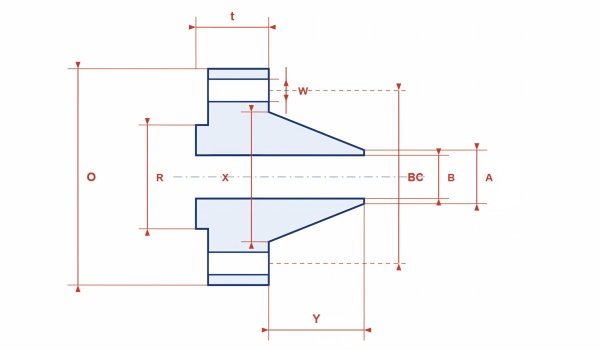
Figure 1 — Welding neck flange in section. O, t, R, BC and the bolt hole diameter are common to all flange types; X, Y, A and B apply to the welding neck. The raised face is exaggerated in the sketch: its actual height is 1.6 mm for Class 150 and 300.
| Letter |
Definition |
Notes |
| O |
Outside diameter of the flange |
Sets the space envelope; larger than the bolt circle by at least one bolt hole diameter |
| t |
Minimum flange thickness |
Includes the raised face for Classes 150 and 300. The plain body thickness is t − 1.6 mm |
| R |
Diameter of the raised face |
The gasket seating surface; the gasket inside diameter must be bored to R or slightly larger |
| BC |
Bolt circle diameter |
Centre-line of the bolt holes. Bolt holes straddle the flange centre lines, not the other way round |
| Bolt holes |
Number, nominal bolt diameter and hole diameter |
The hole is drilled 3.2 mm (1/8 in) larger than the bolt |
| X |
Diameter at the base of the hub (WN only) |
Hub outside diameter where it meets the flange face |
| Y |
Length through the hub (WN only) |
Measured from the flange face to the weld end |
| A |
Outside diameter at the weld end (WN only) |
Equals the outside diameter of the matching pipe |
| B |
Bore (WN, SO, SW, LJ stub end) |
Machined to match the pipe schedule ordered. B is not a fixed value for a given NPS |
4. Welding Neck Flange Dimensions — Class 150
| NPS |
DN |
O (mm) |
t (mm) |
R (mm) |
BC (mm) |
Bolts × dia. |
Hole dia. (mm) |
Y (mm) |
| 1/2 |
15 |
89.0 |
11.2 |
34.9 |
60.5 |
4 × 1/2" |
15.7 |
46 |
| 3/4 |
20 |
98.5 |
12.7 |
42.9 |
69.9 |
4 × 1/2" |
15.7 |
51 |
| 1 |
25 |
108.0 |
14.2 |
50.8 |
79.2 |
4 × 1/2" |
15.7 |
54 |
| 1-1/4 |
32 |
117.5 |
15.7 |
63.5 |
88.9 |
4 × 1/2" |
15.7 |
56 |
| 1-1/2 |
40 |
127.0 |
17.5 |
73.2 |
98.6 |
4 × 1/2" |
15.7 |
60 |
| 2 |
50 |
152.4 |
19.1 |
92.1 |
120.7 |
4 × 5/8" |
19.1 |
62 |
| 2-1/2 |
65 |
177.8 |
22.4 |
104.6 |
139.7 |
4 × 5/8" |
19.1 |
68 |
| 3 |
80 |
190.5 |
23.9 |
127.0 |
152.4 |
4 × 5/8" |
19.1 |
68 |
| 3-1/2 |
90 |
215.9 |
23.9 |
139.7 |
177.8 |
8 × 5/8" |
19.1 |
70 |
| 4 |
100 |
228.6 |
23.9 |
157.2 |
190.5 |
8 × 5/8" |
19.1 |
75 |
| 5 |
125 |
254.0 |
23.9 |
185.7 |
215.9 |
8 × 3/4" |
22.4 |
87 |
| 6 |
150 |
279.4 |
25.4 |
215.9 |
241.3 |
8 × 3/4" |
22.4 |
87 |
| 8 |
200 |
342.9 |
28.4 |
269.7 |
298.5 |
8 × 3/4" |
22.4 |
100 |
| 10 |
250 |
406.4 |
30.2 |
323.9 |
362.0 |
12 × 7/8" |
25.4 |
100 |
| 12 |
300 |
482.6 |
31.8 |
381.0 |
431.8 |
12 × 7/8" |
25.4 |
113 |
| 14 |
350 |
533.4 |
35.1 |
412.8 |
476.3 |
12 × 1" |
28.4 |
125 |
| 16 |
400 |
596.9 |
36.6 |
469.9 |
539.8 |
16 × 1" |
28.4 |
125 |
| 18 |
450 |
635.0 |
39.6 |
533.4 |
577.9 |
16 × 1-1/8" |
31.8 |
138 |
| 20 |
500 |
698.5 |
42.9 |
584.2 |
635.0 |
20 × 1-1/8" |
31.8 |
143 |
| 24 |
600 |
812.8 |
47.8 |
692.2 |
749.3 |
20 × 1-1/4" |
35.1 |
151 |
NPS 22 (DN 550) is also tabulated in ASME B16.5 for both classes and is omitted from the tables above; take those rows from the standard.
5. Welding Neck Flange Dimensions — Class 300
| NPS |
DN |
O (mm) |
t (mm) |
R (mm) |
BC (mm) |
Bolts × dia. |
Hole dia. (mm) |
Y (mm) |
| 1/2 |
15 |
95.3 |
14.2 |
34.9 |
66.5 |
4 × 1/2" |
15.7 |
52.3 |
| 3/4 |
20 |
117.5 |
15.7 |
42.9 |
82.6 |
4 × 5/8" |
19.1 |
57.2 |
| 1 |
25 |
124.0 |
17.5 |
50.8 |
88.9 |
4 × 5/8" |
19.1 |
62.0 |
| 1-1/4 |
32 |
133.4 |
19.1 |
63.5 |
98.6 |
4 × 5/8" |
19.1 |
65.0 |
| 1-1/2 |
40 |
155.4 |
20.6 |
73.2 |
114.3 |
4 × 3/4" |
22.4 |
68.3 |
| 2 |
50 |
165.1 |
22.4 |
92.1 |
127.0 |
8 × 5/8" |
19.1 |
69.9 |
| 2-1/2 |
65 |
190.5 |
25.4 |
104.6 |
149.4 |
8 × 3/4" |
22.4 |
76.2 |
| 3 |
80 |
210.0 |
28.4 |
127.0 |
168.1 |
8 × 3/4" |
22.4 |
79.2 |
| 3-1/2 |
90 |
228.6 |
30.2 |
139.7 |
184.2 |
8 × 7/8" |
25.4 |
81.0 |
| 4 |
100 |
254.0 |
31.8 |
157.2 |
200.0 |
8 × 3/4" |
22.4 |
85.9 |
| 5 |
125 |
279.4 |
35.1 |
185.7 |
235.0 |
8 × 3/4" |
22.4 |
98.6 |
| 6 |
150 |
317.5 |
36.6 |
215.9 |
269.7 |
12 × 3/4" |
22.4 |
98.6 |
| 8 |
200 |
381.0 |
41.1 |
269.7 |
330.2 |
12 × 7/8" |
25.4 |
111.3 |
| 10 |
250 |
444.5 |
47.8 |
323.9 |
387.4 |
16 × 1" |
28.4 |
117.3 |
| 12 |
300 |
520.7 |
50.8 |
381.0 |
450.9 |
16 × 1-1/8" |
31.8 |
130.0 |
| 14 |
350 |
584.2 |
53.8 |
412.8 |
514.4 |
20 × 1-1/8" |
31.8 |
142.7 |
| 16 |
400 |
647.7 |
57.2 |
469.9 |
571.5 |
20 × 1-1/4" |
35.1 |
146.1 |
| 18 |
450 |
711.2 |
60.5 |
533.4 |
628.7 |
24 × 1-1/4" |
35.1 |
158.8 |
| 20 |
500 |
774.7 |
63.5 |
584.2 |
685.8 |
24 × 1-1/4" |
35.1 |
162.1 |
| 24 |
600 |
914.4 |
69.9 |
692.2 |
812.8 |
24 × 1-1/2" |
41.1 |
168.1 |
Thickness t is the ASME B16.5 minimum flange thickness and already includes the raised face: 1.6 mm (1/16 in) for Classes 150 and 300. If your drawing needs the plain body thickness, subtract 1.6 mm — for example the Class 150 NPS 4 body is 23.9 − 1.6 = 22.3 mm.
Y is the length through the hub, measured from the flange face. Published tables differ by about 1.6 mm on this dimension depending on whether the raised face is counted; allow for that when the hub length is critical to a weld fit-up.
Bore B is not tabulated here because it is machined to the pipe schedule you order, not fixed by the standard.
6. Facing
| Facing |
Raised face height |
Where it is used |
| Raised face (RF) |
1.6 mm (1/16 in) for Class 150 and 300; 6.4 mm (1/4 in) for Class 400 and above |
The default facing. A spiral-wound or sheet gasket seats on the raised band |
| Flat face (FF) |
None |
Mating to cast iron, bronze or FRP equipment and to valves with a flat face, where a raised face would crack the softer component |
| Ring joint (RTJ) |
None; a machined groove instead |
High-pressure and high-temperature service, normally Class 600 and above. Requires a metallic ring gasket to ASME B16.20 |
| Tongue and groove / male and female |
Small raised and recessed steps |
Older specifications and specific confined-gasket services |
7. Bolting and Gaskets
B16.5 gives the bolt circle, the number of bolt holes and the hole diameter. Bolts themselves are covered by ASTM A193 (studs) and A194 (nuts), and are ordered separately. Class 150 and Class 300 flanges are also commonly assembled with machine bolts, whereas stud bolts are the rule from Class 600 upward and for all critical service.
Bolt hole clearance Hole diameter is the bolt diameter plus 3.2 mm (1/8 in), which is why hole sizes in the tables are not round numbers.
Thread series Inch sizes in the B16.5 tables are the nominal UNC sizes. Metric equivalents are used in the parallel metric publication and are given here for reference only.
Gasket outlines ASME B16.20 (spiral wound, ring joint, jacketed) and B16.21 (non-metallic sheet) give the gaskets that fit these facings.
Common metric equivalents 1/2 in = M14, 5/8 in = M16, 3/4 in = M20, 7/8 in = M22, 1 in = M24, 1-1/8 in = M27, 1-1/4 in = M30, 1-1/2 in = M36.
8. Pressure–Temperature Ratings
Ratings are tabulated by material group, not by class alone. The table below is for Group 1.1 carbon steel (ASTM A105 forged, A216 WCB cast), which is the group that covers the majority of carbon steel flanges. Intermediate temperatures may be interpolated linearly; interpolation between classes is not permitted.
| Temperature (°C) |
Class 150 (bar) |
Class 300 (bar) |
| -29 to 38 |
19.6 |
51.1 |
| 100 |
17.7 |
46.6 |
| 200 |
13.8 |
43.8 |
| 300 |
10.2 |
39.8 |
| 400 |
6.5 |
34.7 |
| 450 |
4.6 |
23.0 |
| 500 |
2.8 |
11.8 |
| 538 |
1.4 |
5.9 |
Values are from ASME B16.5 Table 2-1.1, gauge pressure. Alloy, stainless, duplex and nickel alloy flanges are rated under their own material groups and may be rated higher or lower at the same temperature. Always read the rating from the table for the material actually ordered, not from the class number.
9. Flange Materials
| Group |
Specification |
Typical grades |
| Carbon steel |
ASTM A105, A216 WCB |
A105, WCB |
| Low-temperature carbon steel |
ASTM A350, A352 |
LF2, LCB, LC3 |
| Alloy steel |
ASTM A182, A217 |
F1, F5, F9, F11, F22, F91, WC6, WC9, C12A |
| Austenitic stainless steel |
ASTM A182, A351 |
F304/304L, F316/316L, F321, F347, CF8, CF8M |
| Duplex and super duplex |
ASTM A182, A995 |
F51 (S31803), F53 (S32750), F55 (S32760), 4A, 5A, 6A |
| Nickel alloys |
ASTM B564, A494 |
Inconel 600/625/825, Incoloy 800/800H, Monel 400, Hastelloy C276, Alloy 20, CW-12MW |
10. Marking, Traceability and NDT
B16.5 requires each flange to be marked with the manufacturer, the material designation, the class, the size and the facing where it is not the default. Chemical and mechanical certification to EN 10204 3.1 is normal for project work, and heat-number transfer to the finished flange is what makes that certification meaningful.
Standard surface treatment Solution annealing for austenitic grades, normalising for carbon and alloy steel forgings. Hardness testing for the sour-service grades.
Non-destructive examination Not required by B16.5 as a routine. UT, MT or PT is a purchaser requirement and must be stated on the purchase order.
Dimensional check Outside diameter, thickness, bolt circle, bolt hole diameter and count, facing and bore are the dimensions worth measuring on receipt.
Documentation Mill test certificate, and where specified a third-party inspection release note.
11. Related Standards
| Standard |
Title and relevance |
| ASME B16.20 |
Metallic Gaskets for Pipe Flanges: Ring-Joint, Spiral-Wound and Jacketed |
| ASME B16.21 |
Non-metallic Flat Gaskets for Pipe Flanges |
| ASME B16.36 |
Orifice Flanges, Classes 300 to 2500 |
| ASME B16.47 |
Large Diameter Steel Flanges, NPS 26 through NPS 60 |
| ASME B16.48 |
Steel Line Blanks |
| ASME B16.9 |
Factory-Made Wrought Buttwelding Fittings (for the weld-neck-to-pipe joint) |
| ASME B31.1 / B31.3 |
Power Piping / Process Piping: flange assembly, bolting and joint rules |
| ASTM A193 / A194 |
Alloy-Steel and Stainless Steel Bolting / Carbon and Alloy Steel Nuts |
| MSS SP-25 |
Standard Marking System for Valves, Fittings, Flanges and Unions |
12. How to Order
| Order element |
Specify |
Example |
| Standard |
ASME B16.5 |
B16.5 |
| Flange type |
WN, SO, SW, THD, LJ, BL, reducing, LWN |
Weld neck |
| Pressure class |
150 / 300 / 400 / 600 / 900 / 1500 / 2500 |
Class 150 |
| Size |
NPS |
NPS 4 |
| Facing |
RF, FF or RTJ |
RF |
| Bore or schedule |
Pipe schedule the bore must match |
Sch 40 |
| Material grade |
Per purchase order |
ASTM A105 |
| Bolting and gasket |
Ordered separately unless bundled |
A193 B7 studs with A194 2H nuts, B16.20 spiral wound gasket |
| Certification |
Certificate type if required |
EN 10204 3.1 MTC |
13. FAQ — Frequently Asked Questions
Does a Class 150 flange mean 150 psi?
No. The class number is a pressure–temperature designation. For Group 1.1 carbon steel, Class 150 is rated 19.6 bar (285 psi) at ambient temperature and falls to 2.8 bar at 500 °C. Class 300 is rated 51.1 bar (740 psi) at ambient.
Is the raised face height included in the flange thickness?
Yes for Classes 150 and 300, where the raised face is 1.6 mm and is included in the tabulated minimum thickness t. For Class 400 and above the raised face is 6.4 mm; check the notes in the standard for how it is accounted for in the tables you are using. If you need the plain body thickness for Class 150 or 300, subtract 1.6 mm from t.
Can a Class 150 flange be bolted to a Class 300 flange?
No. Bolt circle, bolt count, bolt size, facing and thickness all differ between classes. Flanges of different classes never mate directly; use the same class on both sides of the joint, or a reducing spool with a flange of each class at its ends.
What is the difference between a welding neck and a slip-on flange?
A welding neck flange is butt-welded to the pipe and has a tapered hub that transfers the load gradually, so it withstands fatigue and thermal cycling far better. A slip-on flange slides over the pipe and is fillet-welded on both sides; it is cheaper and easier to align, but its fatigue resistance is roughly a third of a welding neck flange of the same class.
How many bolts does a Class 300 NPS 2 flange take?
Eight bolts of 5/8 in nominal diameter, on a 127.0 mm bolt circle, with 19.1 mm holes. The same size in Class 150 takes four 5/8 in bolts on a 120.7 mm circle. This is why a Class 150 and a Class 300 flange cannot be interchanged.
Are bolt holes on the flange centre lines?
No. Bolt holes straddle the flange centre lines so that the flange can be rotated and still mate. The number of holes is always a multiple of four.
What is the raised face diameter used for?
R is the diameter of the raised band that carries the gasket. The gasket inside diameter must clear R so that the gasket is not crushed against the bore, and the outside diameter must sit inside the bolt circle.
Which flange standard applies above NPS 24?
ASME B16.47 covers NPS 26 through NPS 60 in two series, Series A (formerly MSS SP-44) and Series B (formerly API 605). B16.5 stops at NPS 24.