General-Purpose 18/8 Austenitic Stainless Steel for Pipe, Fittings & Flanges
|
UNS NUMBER
S30400
|
ALLOY FAMILY
Austenitic (18/8)
|
STRUCTURE
100% Austenite
|
UTS (MIN)
≥515 MPa
|
MAX TEMP
~870°C
|
DENSITY
7.93 g/cm³
|
|
Stainless Steel 304 (UNS S30400) is the original 18/8 austenitic grade and still the world volume leader. With chromium 18–20% and nickel 8–10.5%, it delivers good corrosion resistance, formability, and weldability at the lowest cost of any stainless family. It is the default material for general process, water, and architectural piping where chlorides are modest.
|
|
Cr
18–20%
PREN contributor; oxidation
|
Ni
8–10.5%
Austenite stabilizer
|
Mo
— (none)
Not added in 304
|
N
≤0.10%
Minor, varies by melt
|
|
UTS
≥515 MPa
|
YS 0.2%
≥205 MPa
|
Elong.
≥40%
|
Service
-196~870°C
|
What is Stainless Steel 304?
304 is a fully austenitic chromium-nickel stainless steel first standardized in the 1930s. The 18% chromium forms a self-healing passive oxide film that resists ordinary atmospheric and aqueous corrosion, while the 8% nickel keeps the structure fully austenitic so the steel stays tough and ductile down to cryogenic temperatures. It cannot be hardened by heat treatment and is supplied in the solution-annealed condition.
Because it contains no molybdenum, 304 sits at a Pitting Resistance Equivalent (PREN) of roughly 19. That is enough for most fresh water, mild chemicals, and indoor service, but it is vulnerable to pitting and crevice corrosion once chloride levels or temperatures climb. Where that matters, the molybdenum-bearing 316 family is the usual step-up. For welded fabrications that cannot be post-weld annealed, the low-carbon 304L is specified instead.
Chemical Composition (Weight %)
| Element |
Min (%) |
Max (%) |
Role in Alloy |
| Chromium (Cr) |
18.0 |
20.0 |
Oxidation resistance; PREN contributor |
| Nickel (Ni) |
8.0 |
10.5 |
Austenite stabilizer; toughness |
| Carbon (C) |
— |
0.080 |
Kept low; 0.04–0.10% risks sensitization on slow cooling |
| Manganese (Mn) |
— |
2.00 |
Deoxidizer; hot-work aid |
| Silicon (Si) |
— |
1.00 |
Deoxidizer |
| Phosphorus (P) |
— |
0.045 |
Impurity; keep low |
| Sulfur (S) |
— |
0.030 |
Impurity; keep low |
| Nitrogen (N) |
— |
0.10 |
Minor austenite aid |
| Iron (Fe) |
Balance |
— |
Matrix former |
★ Carbon in 304 runs up to 0.08%. In thick sections or slow cooling after welding, chromium carbide can precipitate at grain boundaries (sensitization) between 425–815°C, lowering intergranular corrosion resistance. For weldments that will not be annealed, use 304L (C ≤ 0.030%).
Mechanical Properties
304 is strengthened by cold work rather than heat treatment. The values below are for the solution-annealed condition per ASTM A240, A182 (F304), and A312 (TP304).
| Condition / Form |
UTS (MPa) |
YS 0.2% (MPa) |
Elong. % (min) |
Hardness (max) |
| Minimum (ASTM A240 / A182 F304) |
≥515 |
≥205 |
40 |
201 HBW (92 HRB) |
| Typical mill-annealed |
515–720 |
205–350 |
50–60 |
150–190 HBW |
Elastic constants: Modulus of Elasticity 193 GPa; Shear Modulus 77 GPa; Poisson's Ratio 0.29. Cold working raises yield and tensile strength substantially (e.g. 1/4-hard 304 reaches ~515 MPa yield) at the cost of ductility and corrosion margin.
Physical Properties
| Property |
Value |
Note |
| Density |
7.93 g/cm³ |
Slightly above 316L |
| Melting Range |
1400–1450°C |
Solidus ~1400°C |
| Thermal Conductivity (100°C) |
16.2 W/m·K |
Comparable to other austenitics |
| Thermal Expansion (20–100°C) |
17.2 ×10⁻⁶ /K |
Higher than carbon steel |
| Specific Heat |
500 J/kg·K |
At 21°C |
| Electrical Resistivity |
0.72 µΩ·m |
At 21°C |
| Magnetic Property |
Non-magnetic* |
*Slight magnetism after heavy cold work |
| PREN (Pitting Resistance) |
~19 |
PREN = %Cr + 3.3×%Mo + 16×%N |
Corrosion Resistance
General & Atmospheric Service
304 resists rain, steam, food, and most organic chemicals. It is the standard for brewhouse, dairy, and architectural trim. In chloride-free water it performs indefinitely at ambient temperature.
Pitting & Crevice Corrosion
Without molybdenum, 304 has a Critical Pitting Temperature of only about 10–15°C in ferric chloride. It pits in coastal air, brackish water, and anywhere chlorides concentrate (gasket crevices, standing water). This is the main reason 316 replaced it offshore.
Intergranular (Weld) Attack
Slow cooling through 425–815°C lets carbon tie up chromium as Cr₂₃C₆ at grain boundaries, starving adjacent metal of chromium. Use 304L, or stabilize with 321/347, for welded structures that stay in the sensitizing range.
Acids & High Temperature
304 handles nitric and many organic acids, but not hydrochloric or reducing sulfuric. Above ~870°C it loses oxidation resistance versus 310/310S; 304 is not a heat-resistant grade.
Stainless Steel 304 vs Similar Grades — Selection Guide
| If you need... |
Choose... |
Why |
| General water, food, architectural, low chloride |
Stainless Steel 304 |
Cheapest stainless; adequate corrosion margin |
| Welded vessel not post-weld annealed |
304L |
C ≤ 0.030% avoids sensitization |
| Chloride, seawater, coastal atmosphere |
316 / 316L |
Molybdenum raises PREN to ~26 |
| High-temp furnace or 1000°C+ service |
310S / 253MA |
Higher Cr/Ni for oxidation resistance |
| Maximum pitting + acid (seawater) |
904L / 254SMO |
PREN 36–45, copper/nitrogen boosted |
Applicable Standards
| Standard |
Product Form |
| ASTM A240 |
Plate, sheet, strip |
| ASTM A182 F304 |
Forged flanges & fittings |
| ASTM A403 WP304 |
Butt-weld fittings |
| ASTM A312 TP304 |
Seamless & welded pipe |
| ASTM A213 / A269 |
Tube |
| ASTM A276 / A479 |
Bar, rod, forging stock |
HT PIPE Supply — Stainless Steel 304 Product Forms
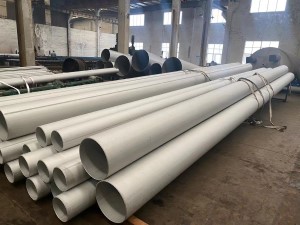
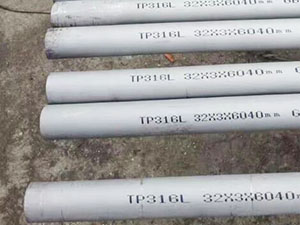
All 304 products from HT PIPE are supplied solution-annealed with EN 10204 3.1/3.2 MTRs. For welded fabrications we recommend dual-stock of 304L to avoid sensitization risk.
Project Experience — Stainless Steel 304
HT PIPE supplies 304 pipe, fittings, and flanges for food, beverage, water, and general process projects worldwide.
| Project |
Product |
Specification |
| Dairy & Beverage Process Line (Europe) |
304 Pipe + BW Fittings |
A312, A403 |
| Architectural Handrail & Trim (Middle East) |
304 Bar + Plate |
A276, A240 |
| Municipal Water Treatment (Southeast Asia) |
304 Flanges + Pipe |
A182 F304, A312 |
Our technical team advises on 304 vs 304L selection and provides PMI verification for chloride-sensitive service.
| FREQUENTLY ASKED QUESTIONS |
|
FAQ — Stainless Steel 304
| What is the difference between 304 and 304L? |
| 304 allows carbon up to 0.08%; 304L caps it at 0.030%. The lower carbon prevents chromium-carbide sensitization during welding, so 304L is the right choice for welded structures that will not be post-weld annealed. Mechanical minima are slightly lower for 304L (485 MPa UTS, 170 MPa yield). |
| Is 304 stainless magnetic? |
| In the annealed condition 304 is essentially non-magnetic. Heavy cold working (bending, drawing, heading) can induce slight magnetism, but a strong attraction indicates the wrong grade or ferritic contamination. |
| Can 304 be used in seawater? |
| Not recommended. Without molybdenum, 304 pits readily in chloride environments, typically within months in seawater or coastal splash zones. Use 316L for ambient seawater and 904L/254SMO for aggressive seawater. |
| What filler metal is used for 304? |
| ER308 / E308 for matching chemistry. For joints that may see the sensitizing range, drop to ER308L to keep the weld deposit low-carbon. |
| What temperature can 304 withstand? |
| Continuous service to about 870°C in air is acceptable for strength; oxidation resistance is good to roughly 925°C (intermittent). For sustained 1000°C+ furnace work, 310S or 253MA is the better choice. |
|
Need Stainless Steel 304 for Your Project?
HT PIPE supplies 304 seamless pipe, butt-weld fittings, forged flanges, and plate with full MTR documentation. Contact our technical team for material selection advice and a competitive quotation.
Request a Quote |
|
MATERIAL PAGE
|
COMPARISON
|
MATERIAL PAGE
|
PRODUCT PAGE
|