Low-Carbon Molybdenum-Bearing Austenitic Stainless for Welded Service
|
UNS NUMBER
S31603
|
ALLOY FAMILY
Austenitic (Mo-bearing)
|
STRUCTURE
100% Austenite
|
UTS (MIN)
≥485 MPa
|
MAX TEMP
~870°C
|
DENSITY
7.98 g/cm³
|
|
Stainless Steel 316L (UNS S31603) is the low-carbon version of 316, with carbon capped at 0.030% and the same 2–3% molybdenum. It delivers 316's chloride pitting resistance (PREN ~26) while staying immune to weld sensitization — the default marine, pharmaceutical, and process-welding grade.
|
|
Cr
16–18%
Oxidation resistance
|
Ni
10–14%
Austenite stabilizer
|
Mo
2–3%
Pitting / crevice resistance
|
C
≤0.030%
Low carbon, weld-friendly
|
|
UTS
≥485 MPa
|
YS 0.2%
≥170 MPa
|
Elong.
≥40%
|
Service
-196~870°C
|
What is Stainless Steel 316L?
316L carries the molybdenum-bearing 18/10 chemistry of 316 but restricts carbon to 0.030% maximum. That removes the sensitization mechanism, so welded tanks, pipe, and equipment remain corrosion-resistant as-welded without post-weld heat treatment. It is the most common grade in pharmaceutical, food, and marine fabrication.
The strength floor is slightly lower than 316 (485 MPa UTS, 170 MPa yield versus 515/205). In practice welded assemblies rarely need 316's extra margin, and dual certification (316/316L) is routine so one heat covers both. For warm seawater or aggressive chlorides, step up to 904L, AL6XN, or 254SMO; for high-temperature load, use 316H or a stabilized grade.
Chemical Composition (Weight %)
| Element |
Min (%) |
Max (%) |
Role in Alloy |
| Chromium (Cr) |
16.0 |
18.0 |
Oxidation resistance |
| Nickel (Ni) |
10.0 |
14.0 |
Austenite stabilizer |
| Molybdenum (Mo) |
2.0 |
3.0 |
Pitting / crevice resistance |
| Carbon (C) |
— |
0.030 |
Low carbon prevents sensitization |
| Manganese (Mn) |
— |
2.00 |
Deoxidizer |
| Silicon (Si) |
— |
1.00 |
Deoxidizer |
| Phosphorus (P) |
— |
0.045 |
Impurity |
| Sulfur (S) |
— |
0.030 |
Impurity |
| Nitrogen (N) |
— |
0.10 |
Minor |
| Iron (Fe) |
Balance |
— |
Matrix former |
★ Carbon ≤ 0.030% is the defining limit. 316L is immune to carbide sensitization in the 425–815°C range, so welded fabrications do not require post-weld annealing for corrosion integrity.
Mechanical Properties
Values are for the solution-annealed condition per ASTM A240, A182 (F316L), and A312 (TP316L).
| Condition / Form |
UTS (MPa) |
YS 0.2% (MPa) |
Elong. % (min) |
Hardness (max) |
| Minimum (ASTM A240 / A182 F316L) |
≥485 |
≥170 |
40 |
217 HBW (95 HRB) |
| Typical mill-annealed |
515–680 |
205–330 |
45–55 |
150–195 HBW |
Modulus of Elasticity 193 GPa; Shear Modulus 77 GPa; Poisson's Ratio 0.29. Cold work raises strength. Dual-certified 316/316L material is common.
Physical Properties
| Property |
Value |
Note |
| Density |
7.98 g/cm³ |
Slightly above 304 |
| Melting Range |
1375–1400°C |
Solidus ~1375°C |
| Thermal Conductivity (100°C) |
16.3 W/m·K |
Comparable to austenitics |
| Thermal Expansion (20–100°C) |
16.0 ×10⁻⁶ /K |
Higher than carbon steel |
| Specific Heat |
500 J/kg·K |
At 21°C |
| Electrical Resistivity |
0.74 µΩ·m |
At 21°C |
| Magnetic Property |
Non-magnetic* |
*Slight after cold work |
| PREN (Pitting Resistance) |
~26 |
PREN = %Cr + 3.3×%Mo + 16×%N |
Corrosion Resistance
Welded Fabrications
316L is the standard for welded tanks and piping because the low carbon prevents intergranular attack after welding. No post-weld annealing is needed for corrosion service.
Pitting & Crevice Corrosion
The 2–3% molybdenum gives PREN ~26, better than 304 but still limited in warm/stagnant seawater. It is the default marine grade at ambient temperature with flow.
Pharmaceutical & Food Service
316L is the dominant hygienic grade: easy to polish, cleanable, and corrosion-resistant in CIP/SIP chemicals. Most biopharm tubing is 316L.
High-Temperature Limit
Above ~650°C, sigma-phase formation is possible. For sustained high-temperature load use 316H, 321H, or 347H instead.
Stainless Steel 316L vs Similar Grades — Selection Guide
| If you need... |
Choose... |
Why |
| Welded marine / pharma / process |
316L |
Low carbon, chloride resistant |
| Warm seawater / aggressive Cl⁻ |
904L / 254SMO |
PREN 36–45 |
| High-temp >650°C load |
316H / 321H |
Creep + stabilized |
| General low-chloride, cheaper |
304L |
No molybdenum needed |
| Higher Mo, FGD service |
317L |
Mo 3–4% |
Applicable Standards
| Standard |
Product Form |
| ASTM A240 |
Plate, sheet, strip |
| ASTM A182 F316L |
Forged flanges & fittings |
| ASTM A403 WP316L |
Butt-weld fittings |
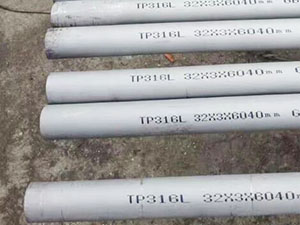
| ASTM A312 TP316L |
Seamless & welded pipe |
| ASTM A213 / A269 |
Tube |
| ASTM A276 / A479 |
Bar, rod, forging stock |
HT PIPE Supply — Stainless Steel 316L Product Forms
| Product Form |
Specifications |
HT PIPE Supply |
| Seamless Pipe |
ASTM A312 TP316L |
✅ Available |
| Welded Pipe |
ASTM A312 TP316L |
✅ Available |
| Forged Flanges |
ASTM A182 F316L, ASME B16.5/B16.47 |
✅ In stock |
| Butt-Weld Fittings |
ASTM A403 WP316L |
✅ Available |
| Plate / Sheet |
ASTM A240 |
✅ Available |
| Bar / Rod |
ASTM A276 / A479 |
✅ Available |
HT PIPE stocks 316L (and dual-certified 316/316L) in pipe, fittings, and flanges, supplied solution-annealed with full MTRs and PMI on request.
Project Experience — Stainless Steel 316L
HT PIPE supplies 316L for marine, pharmaceutical, food, and chemical process systems where as-welded corrosion resistance matters.
| Project |
Product |
Specification |
| Biopharm Clean Utility (Europe) |
316L Tube + Fittings |
A269, A403 |
| Offshore Seawater Cooling (Middle East) |
316L Pipe + Flanges |
A312, A182 F316L |
| Food Processing Line (Asia) |
316L Plate + Forgings |
A240, A182 |
We support welding procedure specification (WPS) and PMI verification for 316L systems.
| FREQUENTLY ASKED QUESTIONS |
|
FAQ — Stainless Steel 316L
| Why choose 316L over 316? |
| 316L's carbon is capped at 0.030% so welded joints do not sensitize and do not need post-weld annealing. Choose it for any welded component that will not be heat-treated afterward. |
| Is 316L weaker than 316? |
| Marginally: minimum UTS 485 MPa and yield 170 MPa versus 515/205 for 316. Welded structures rarely need the extra margin, and dual certification covers both specs. |
| Is 316L suitable for seawater? |
| At ambient temperature with flow it is the standard marine grade, but it can pit in warm, stagnant, or creviced seawater. For warm seawater use 904L, AL6XN, or 254SMO. |
| What filler is used for 316L? |
| ER316L / E316L keeps the weld deposit low-carbon and matching. Avoid plain 316 filler if the joint may sit in the sensitizing range. |
| Does 316L need post-weld heat treatment? |
| For corrosion integrity, no. The low carbon prevents sensitization. PWHT is considered only for special stress-relief cases, not for carbide control. |
|
Need Stainless Steel 316L for Your Project?
HT PIPE supplies 316L seamless pipe, butt-weld fittings, forged flanges, and plate with full MTR documentation. Contact our technical team for welding and material selection advice.
Request a Quote |
|
MATERIAL PAGE
|
COMPARISON
|
MATERIAL PAGE
|
PRODUCT PAGE
|