High-Carbon 18/8 Austenitic Stainless for Elevated-Temperature Service
|
UNS NUMBER
S30409
|
ALLOY FAMILY
Austenitic (18/8)
|
STRUCTURE
100% Austenite
|
UTS (MIN)
≥515 MPa
|
MAX TEMP
~870°C
|
DENSITY
7.93 g/cm³
|
|
Stainless Steel 304H (UNS S30409) is the high-carbon variant of 304, with carbon held at 0.04–0.10% to deliver higher creep and stress-rupture strength above 525°C. It is used in boiler superheaters, reheaters, and high-temperature process piping where standard 304 would fall out of the ASME allowable-stress range.
|
|
Cr
18–20%
Oxidation resistance
|
Ni
8–11%
Austenite stabilizer
|
C
0.04–0.10%
Controlled high carbon for creep
|
N
≤0.10%
Minor
|
|
UTS
≥515 MPa
|
YS 0.2%
≥205 MPa
|
Elong.
≥40%
|
Service
up to ~870°C
|
What is Stainless Steel 304H?
304H keeps the familiar 18/8 chromium-nickel base but tightens carbon to a 0.04–0.10% band. That carbon floor, plus a minimum grain size requirement, gives it certified creep and stress-rupture strength at temperatures where annealed 304 no longer carries code-listed allowable stresses. EN equivalents are 1.4948; the Chinese designation is 07Cr19Ni10.
The cost of the higher carbon is the same sensitization risk as 304: weldments in the 425–815°C range can sensitize, so 304H is not the choice for general welded tanks. It is a high-temperature, high-stress material — boiler and refinery piping, headers, and superheater tubes. For welded high-temperature joints that must also avoid sensitization, the stabilized grades 321H and 347H are the engineered answer.
Chemical Composition (Weight %)
| Element |
Min (%) |
Max (%) |
Role in Alloy |
| Chromium (Cr) |
18.0 |
20.0 |
Oxidation resistance |
| Nickel (Ni) |
8.0 |
11.0 |
Austenite stabilizer |
| Carbon (C) |
0.04 |
0.10 |
Defining range for creep strength |
| Manganese (Mn) |
— |
2.00 |
Deoxidizer |
| Silicon (Si) |
— |
1.00 |
Deoxidizer |
| Phosphorus (P) |
— |
0.045 |
Impurity |
| Sulfur (S) |
— |
0.030 |
Impurity |
| Nitrogen (N) |
— |
0.10 |
Minor |
| Iron (Fe) |
Balance |
— |
Matrix former |
★ Carbon 0.04–0.10% with a minimum grain size (ASTM No. 7 or coarser) is the defining requirement that separates 304H from 304/304L and underwrites its elevated-temperature allowable stresses.
Mechanical Properties
Values are for the solution-annealed condition per ASTM A240, A182 (F304H), and A312 (TP304H). The real advantage appears in ASME time-dependent allowable stresses above 525°C.
| Condition / Form |
UTS (MPa) |
YS 0.2% (MPa) |
Elong. % (min) |
Hardness (max) |
| Minimum (ASTM A240 / A182 F304H) |
≥515 |
≥205 |
40 |
201 HBW (92 HRB) |
| Typical mill-annealed |
515–720 |
205–350 |
45–55 |
150–190 HBW |
Modulus of Elasticity 193 GPa. Creep and stress-rupture values per ASME II are the basis for high-temperature design; 304H carries code-listed allowable stresses to about 870°C whereas standard 304 does not.
Physical Properties
| Property |
Value |
Note |
| Density |
7.93 g/cm³ |
Same as 304 |
| Melting Range |
1400–1450°C |
Solidus ~1400°C |
| Thermal Conductivity (100°C) |
16.2 W/m·K |
Comparable to austenitics |
| Thermal Expansion (20–100°C) |
17.2 ×10⁻⁶ /K |
Higher than carbon steel |
| Specific Heat |
500 J/kg·K |
At 21°C |
| Electrical Resistivity |
0.72 µΩ·m |
At 21°C |
| Magnetic Property |
Non-magnetic* |
*Slight after cold work |
| PREN (Pitting Resistance) |
~19 |
No molybdenum |
Corrosion Resistance
High-Temperature Strength
304H's reason to exist. The controlled carbon and coarse grain deliver creep-rupture strength that lets it carry ASME allowable stresses in boiler and superheater service to roughly 870°C.
General Corrosion
Same 18/8 resistance as 304 in fresh water, steam, and mild chemicals. Adequate for most high-temperature process gases and steam.
Sensitization Risk
Because carbon is 0.04–0.10%, weldments can sensitize in the 425–815°C range during shutdowns, leading to intergranular attack in refinery polythionic-acid service. Stabilized 321H/347H avoid this.
Pitting in Chlorides
No molybdenum (PREN ~19): 304H is not for seawater or chloride service. Use 316H or a molybdenum grade where chlorides coexist with heat.
Stainless Steel 304H vs Similar Grades — Selection Guide
| If you need... |
Choose... |
Why |
| Boiler superheater / reheater, >525°C |
304H |
Code-listed creep strength to ~870°C |
| High-temp pipe, also chlorides |
316H |
Molybdenum margin + creep strength |
| Welded high-temp, avoid sensitization |
321H / 347H |
Stabilized carbides |
| Furnace 1000°C+, no load |
310S / 253MA |
Better oxidation resistance |
Applicable Standards
| Standard |
Product Form |
| ASTM A240 |
Plate, sheet, strip |
| ASTM A182 F304H |
Forged flanges & fittings |
| ASTM A312 TP304H |
Seamless & welded pipe |
| ASTM A213 |
Boiler & superheater tube |
| ASTM A276 / A479 |
Bar, rod, forging stock |
| EN 1.4948 / GB 07Cr19Ni10 |
European / Chinese equiv. |
HT PIPE Supply — Stainless Steel 304H Product Forms
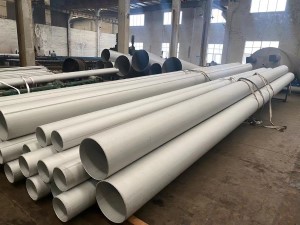
HT PIPE supplies 304H with controlled carbon and coarse-grain practice to EN 1.4948 / GB 07Cr19Ni10 equivalents, with MTRs showing grain size and high-temperature properties.
Project Experience — Stainless Steel 304H
HT PIPE supplies 304H for boiler, superheater, and high-temperature process piping where creep strength governs.
| Project |
Product |
Specification |
| Power Plant Superheater (Asia) |
304H Tube + Pipe |
A213, A312 |
| Refinery High-Temp Header (Middle East) |
304H Flanges + Forgings |
A182 F304H |
| Chemical Reactor Outlet (China) |
304H Pipe + Fittings |
A312, A403 |
We verify grain size and provide ASME high-temperature allowable-stress data for 304H creep design.
| FREQUENTLY ASKED QUESTIONS |
|
FAQ — Stainless Steel 304H
| What makes 304H different from 304? |
| Carbon is held at 0.04–0.10% (with a minimum grain size) instead of ≤0.08%. That gives 304H certified creep and stress-rupture strength at elevated temperature, where plain 304 drops out of the ASME allowable-stress range. |
| What temperature is 304H good for? |
| It carries code-listed allowable stresses to roughly 870°C in continuous high-temperature service. Below the creep range (under ~525°C), plain 304 or 304L is the economical choice. |
| Is 304H weldable? |
| Yes, by standard austenitic methods using ER308H / E308H filler to keep the weld metal creep-resistant. Note the sensitization risk in the 425–815°C range during shutdowns. |
| When should I use 321H or 347H instead? |
| When the welded joint must stay in the sensitizing range and resist polythionic-acid stress corrosion during refinery shutdowns. The stabilized grades avoid intergranular attack that 304H can suffer. |
| What are the equivalents of 304H? |
| EN 1.4948, GB 07Cr19Ni10. Both match the UNS S30409 high-carbon chemistry and grain-size practice. |
|
Need Stainless Steel 304H for High-Temperature Service?
HT PIPE supplies 304H (UNS S30409) pipe, tube, flanges, and fittings with controlled carbon, coarse-grain practice, and high-temperature MTRs. Contact our technical team for creep-design support.
Request a Quote |
|
MATERIAL PAGE
|
MATERIAL PAGE
|
COMPARISON
|
PRODUCT PAGE
|